Should You Build an App for Meta Smart Glasses Yet?
Meta opened its smart glasses platform to outside developers this year, creating a new set of possibilities for companies exploring wearable software.

It also created a lot of reasonable questions.
Can you build something useful on the glasses today? What can the hardware actually do? Can you distribute an app to customers? Do users need to own the glasses? And, perhaps most importantly, is there any advantage to building now rather than waiting for the platform to mature?
For many companies, waiting will make sense. For others, the limitations of the platform are exactly what make the opportunity interesting right now.
Here is what you should understand before deciding whether a Meta glasses app belongs on your roadmap.
If you are looking for the more technical view of the platform, see our Meta Wearables page.
What kind of Meta glasses app can you build?
There are currently two broad approaches.
The first is to extend an existing mobile app with smart glasses capabilities. Your phone application remains the primary application, while the glasses provide a new way to capture information and interact with it.
Instead of taking out a phone, opening the camera, and pointing it at something, a user can simply look at it.
For applications involving inspections, field work, visual assistance, documentation, coaching, or other hands-free workflows, that distinction can be significant.
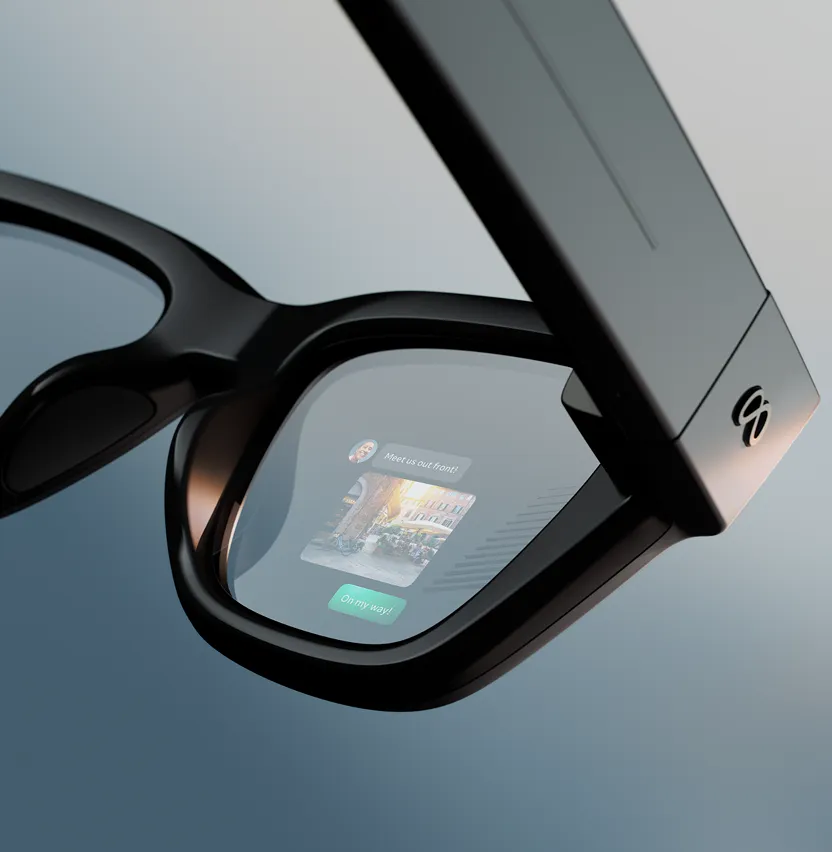
The second approach is a smaller standalone experience built for the Meta Ray-Ban Display, which includes a display in the lens and can support experiences without requiring a companion phone application.
Neither approach is inherently better. The right choice depends on what the user needs to accomplish and where the glasses add something that a phone cannot.
What can an app actually do on the glasses?
It helps to separate input from output.
On the input side, smart glasses are unusually capable. An application can use the camera to see what the wearer sees, capture photos, listen through the microphone, and respond through the speakers.
On the Ray-Ban Display, applications can also present text, images, controls, and video within the wearer’s field of view.
The more important constraint is attention.
Smart glasses are not a smaller smartphone screen. The display is designed for information that can be understood quickly without taking the user out of what they are doing.
That makes them well suited to things like:
- a short instruction
- a status update
- a visual reference
- a confirmation
- a warning
- a next step
- a small amount of contextual information
They are much less suited to dense interfaces, long-form reading, complex configuration, or anything that requires sustained visual attention.
A useful test is simple: does the experience become meaningfully better when the user can keep their hands free and their attention on the world around them?
If the answer is no, the idea may still be valuable, but smart glasses may not be the right interface for it.
Can you distribute a Meta glasses app to customers today?
This is one of the most important limitations of the platform right now.
Meta’s smart glasses development platform is still in Developer Preview. Developers can build applications, run them on physical hardware, and distribute them to a limited group of testers.
What does not yet exist is a public app marketplace where a company can release an application broadly and acquire customers in the same way it might through the Apple App Store or Google Play.
That changes the business case for developing today.
Building now is generally not about launching a large consumer product immediately. It is about validating an idea, learning how users behave on a new type of device, developing platform expertise, or preparing a product before broader distribution becomes available.
If your business case depends on generating meaningful consumer revenue from a Meta glasses app in the near term, the platform is probably too early.
If the value comes from learning, strategic positioning, a controlled deployment, or solving a problem for a known group of users, the timing can be much more compelling.
Do your customers need to own Meta glasses?
Yes.
Any experience you build is naturally limited to people who have access to compatible hardware.
That makes audience composition especially important.
A consumer application aimed at a broad population has a much smaller immediately addressable market on smart glasses than it would on a phone.
The economics can look very different in environments where the organization, rather than the individual user, provides the hardware.
Consider situations such as:
- field technicians receiving glasses as part of their equipment
- warehouse or logistics teams working hands-free
- employees following visual procedures
- training programs providing glasses to participants
- hospitality or event experiences where devices are supplied
- branded demonstrations or experiential marketing
- specialized professional workflows where the hardware has a clear operational benefit
In these cases, adoption does not depend on waiting for every potential user to independently purchase smart glasses.
That makes controlled or enterprise deployments one of the more practical ways to explore the platform today.
Do you also need a mobile app?
It depends on which development model fits the experience.
If you are adding smart glasses capabilities to an existing mobile product, the phone application remains part of the system. The glasses effectively become another interface into that product.
If the experience is small enough to run independently on the Ray-Ban Display, a companion phone application may not be necessary.
For a new concept, a focused standalone experience can sometimes be a useful way to validate the interaction before investing in a larger application ecosystem.
The important question is not whether a phone app is technically required. It is where the application's complexity actually belongs.
How do users control an app without a touchscreen?
This is one of the biggest design differences between smart glasses and traditional mobile software.
The Ray-Ban Display uses a wrist-worn neural input band that interprets subtle muscle signals from the forearm. Small finger movements become application controls.
The interaction vocabulary is intentionally limited. Users can navigate, make selections, and move backward using a small number of gestures rather than tapping a screen.
That limitation has major implications for application design.
Interfaces built around keyboards, long forms, nested navigation, large menus, or precise touch interactions do not translate well.
But the constraint also creates the primary benefit of the platform: interaction can happen without holding a device.
A technician can move through a procedure while holding a tool. A cook can reference the next step without touching a screen. A worker can acknowledge an instruction without stopping what they are doing.
The strongest concepts tend to make that reduced interaction model an advantage rather than something the application has to work around.
How much does a Meta glasses app cost to build?
The answer depends primarily on the scope of the application rather than the novelty of the hardware.
A focused prototype can often be developed in roughly three to four weeks. A more complete application may take eight to twelve weeks or longer depending on backend integrations, computer vision, AI capabilities, authentication, existing systems, and other product requirements.
In general, the development effort is increasingly comparable to a well-scoped mobile application rather than an experimental research project.
Hardware should also be part of the budget.
Some development can happen without constant access to the glasses, but meaningful interaction and display work ultimately needs to be tested on the physical device.
For a serious prototype, plan on having the actual hardware available throughout development and user testing.
Is it too early to build?
Sometimes.
The better question is whether being early creates any meaningful advantage for your particular idea.
Waiting probably makes sense when:
- the experience works just as well on a smartphone
- the business requires near-term consumer distribution
- the target audience has little reason to own smart glasses
- the primary interface requires substantial reading or data entry
- the value proposition depends on capabilities the platform does not yet expose
Building now becomes more interesting when:
- users genuinely benefit from keeping their hands free
- information is useful while the user remains focused on the physical world
- the hardware can reasonably be supplied as part of the product or workflow
- you want to validate a new interaction model before the market becomes crowded
- platform knowledge itself has strategic value to the business
- you expect smart glasses to become important to your category and want to begin learning early
This is less a question of whether smart glasses will become a meaningful computing platform and more a question of whether your use case benefits from participating at this stage of its development.
What happens when Meta changes the platform?
You should expect it to change.
The development tools, APIs, hardware capabilities, and distribution model are still evolving. Applications built during this stage should be designed with that in mind.
A sensible architecture keeps platform-specific code relatively isolated from the parts of the product that contain business logic, data models, AI services, integrations, and other reusable capabilities.
That does not eliminate the cost of platform changes, but it reduces the amount of the product that has to change with them.
For an early platform, adaptability should be part of the technical design rather than an afterthought.
How should you test an idea before committing to a full build?
Start with the assumption that the most important thing to learn is not whether the software can be built.
It is whether the experience is actually better on glasses.
Identify the part of the concept with the most uncertainty and prototype that first.
If the value proposition depends on recognizing something through the camera, test that interaction.
If it depends on providing instructions while someone works, build that workflow.
If it depends on the display, put a minimal version on the actual hardware and see how it feels during real use.
A prototype should answer the question that could invalidate the larger investment.
Sometimes that exercise confirms that smart glasses make an experience dramatically better.
Sometimes it reveals that the same product would be simpler and more useful as a mobile application.
Both are valuable outcomes when you discover them early.
So, should you build now or wait?
Smart glasses are still an early application platform.
Public distribution is limited. The installed base is small compared with mobile. Interaction patterns are constrained, and the development environment will continue to evolve.
Those limitations do not necessarily make the platform unattractive. They define the kinds of ideas that make sense today.
If your product becomes substantially more useful when someone can keep their hands free, maintain awareness of their surroundings, and receive information at the moment it is needed, Meta's glasses are worth exploring now.
If the glasses are simply another screen for an experience that already works well on a phone, waiting for the ecosystem to mature may be the better decision.
The useful starting point is therefore not “How do we build a Meta glasses app?”
It is:
“What becomes possible for our users when they no longer have to reach for a screen?”
If you have an idea and want to understand where it fits within the current platform, tell us what you are considering.
Written by Foundri Studio
Talk to us about agents in your business →